

Deep-sea nodule collection technologies
Two distinct challenges to develop next-generation systems for collecting polymetallic nodules from the deep ocean — sustainably, and at scale.
Identify and support innovative technologies for the collection of polymetallic nodules from depths ranging between 4,500 and 6,000 m i.e., deep-ocean operating conditions.
Proposed solutions should demonstrate:
- Technical feasibility
- Scalability
- Operational reliability
- Energy efficiency
- Environmental sustainability
- Indigenous innovation
- Commercialisation potential
Operating Environment
Proposed technologies must be capable of enduring these extreme deep-sea conditions.
The two challenges
Select a problem statement to explore its background and full scope for innovation. You may enter one or both.
Development of mining system with Innovative Impact less Nodule Collection System with Vertical Riser Transport
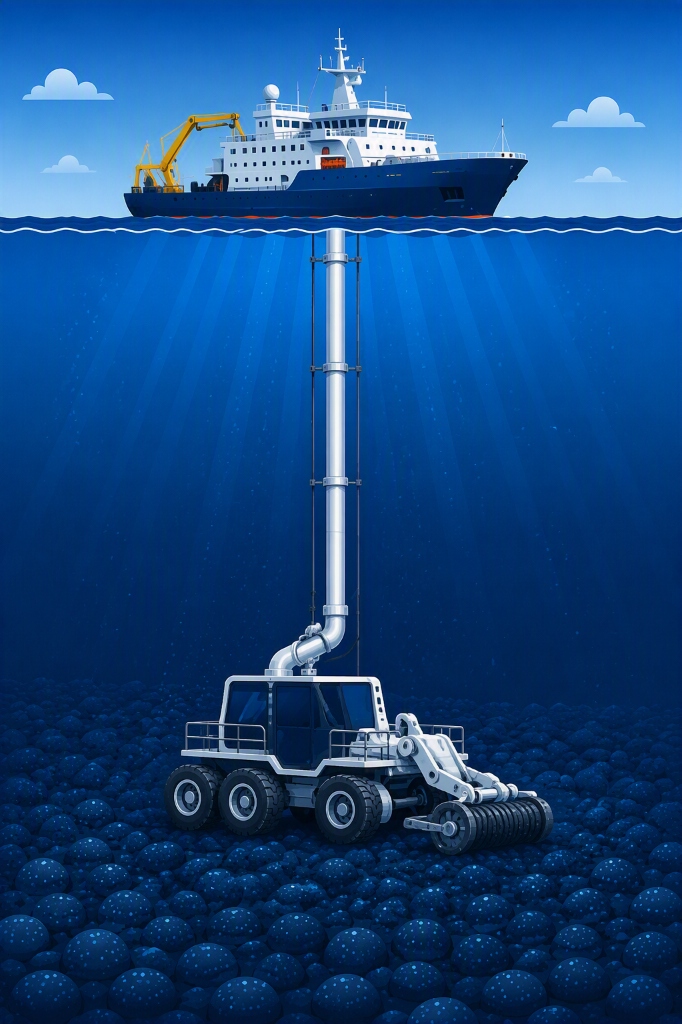
The conventional deep-sea mining architecture employs a tracked seabed collector coupled with a vertical riser and lifting system that transports nodules hydraulically or mechanically to a surface support vessel. While technically mature compared to other concepts, significant challenges remain in Collector efficiency, Sediment management, Hydraulic transport efficiency, Energy consumption, Reliability, System weight, Deployment logistics and Environmental footprint.
- Collector vehicle
- Pick-up mechanism
- Hydraulic collection head
- Mechanical collection head
- Nodule separation
- Water management
- Sediment rejection
- Intelligent navigation
- Autonomous operation
- Riser interface
- Pumping concepts
- Hybrid transport systems
- Energy optimisation
- Condition monitoring
- Modular architecture
Novel ideas beyond the above are encouraged.
Common Technical Requirements
The proposed technology should address these core aspects:
- Pressure-resistant systems
- Corrosion resistance
- Modular construction
- Reliability
- Power architecture
- Redundancy
- Sensors
- Underwater connectors
- Autonomous navigation
- Position estimation
- Mission planning
- Sediment disturbance
- Plume mitigation
- Biodiversity protection
- Habitat recovery
- Noise reduction
- Energy efficiency
Expected Deliverables
- ▹Concept note
- ▹Technical description
- ▹Novelty assessment
- ▹Preliminary design
- ▹Functional architecture
- ▹System block diagram
- ▹Preliminary performance assessment
- ▹Estimated Technology Readiness Level (TRL)
- ▹Development roadmap
- ▹Detailed Project Report (DPR)
- ▹Engineering design
- ▹Mathematical models
- ▹System simulations
- ▹Design calculations
- ▹CAD models
- ▹Risk assessment
- ▹Failure mode analysis
- ▹Environmental impact assessment
- ▹Prototype development plan
- ▹Cost estimation
- ▹Technology development schedule